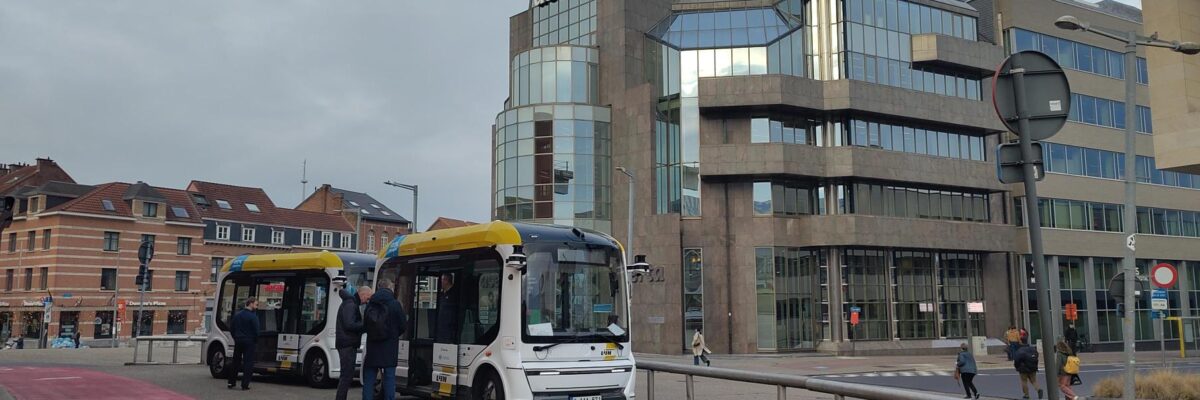
Belgium’s first autonomous public transport shuttles
The Belgian city of Leuven is currently home to an autonomous public transport pilot project. On 22 January 2026, two Level 4 shuttles opened to passengers, operating exclusively in the afternoons as Line 16 (connecting Leuven Station to Heverlee), a 4-kilometre loop chosen for its relevance to students and commuters. A safety officer remains onboard during operation as this is required for the time being by Belgian and EU regulations.
Before passenger service began, engineers conducted centimetre-level HD mapping of Leuven’s city centre. The shuttles continuously compare live sensor data with these maps, enabling accurate positioning and safe navigation—even in complex scenarios like pedestrian crossings and cyclist interactions. In such situations, the shuttles dynamically recalculate their trajectory and proceed along a safe path while prioritising collision avoidance.
Each shuttle relies on a multi-sensor fusion system:
- Lidar for high-resolution 3D mapping and obstacle detection;
- Radar to track moving objects, even in poor weather;
- High-definition cameras for real-time visual input and traffic sign recognition;
- GPS/IMU for precise localisation, cross-referenced with pre-mapped routes.
These sensors feed data into WeRide’s proprietary AI platform, which processes the environment, predicts traffic behaviour, and makes driving decisions in real time. Moreover, the shuttles use V2X (Vehicle-to-Everything) communication to interact with traffic lights and infrastructure, enhancing safety and efficiency.
The pilot will run until at least 2027, with plans to expand and refine the service. For now, the focus is on assessing technology performance and passenger behaviour. The collected data will inform AI training for complex traffic scenarios, guide improvements in user experience, and support policy frameworks for future deployments across Belgium and Europe.
Source: The original article was published here