
JRC report highlights societal priorities in European transport research and innovation
How can transport research contribute to more inclusive, safer and user-centred mobility? A new publication from the European Commission’s Joint Research Centre (JRC), Societal Aspects of Transport in Research and Innovation in Europe 2026, examines how EU-funded research and innovation projects have addressed the societal dimensions of transport over the past decade.
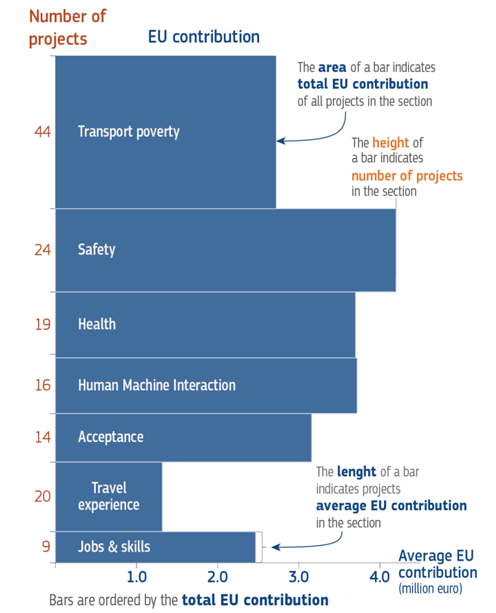
The report reviews 146 projects funded between 2015 and 2025 under Horizon 2020 and Horizon Europe, representing a total EU contribution of €443.6 million. It examines seven areas: transport poverty, safety, travel experience, health, human-machine interaction (HMI), technology acceptance, and jobs and skills.
Transport poverty leads research priorities
Transport poverty was the most frequently addressed topic, accounting for 30% of the projects reviewed, followed by safety (16%), travel experience (14%), health (13%), HMI (11%), technology acceptance (10%), and jobs and skills (6%).
Projects addressing transport poverty explored mobility solutions for people with disabilities, older adults, women, children and people with limited digital skills. The findings highlight the importance of accessible technologies, participatory approaches and inclusive transport planning.
Source: TRIMIS
Implications for connected and automated mobility
The report also identifies important priorities for Connected, Cooperative and Automated Mobility (CCAM). Research on technology acceptance has explored public perceptions of connected and automated vehicles, including concerns related to safety, human-machine interaction, noise and visual pollution.
HMI research has examined communication between drivers, vehicles and vulnerable road users, highlighting the importance of trust, real-time adaptability and human-centred automation design.
The findings also point to the need for comprehensive impact assessments and closer integration of infrastructure, vehicle design and user education to support the successful deployment of emerging technologies.
Towards more inclusive transport systems
Across the seven research areas, the report emphasises the importance of citizen engagement, coordinated policy and industry action, and solutions tailored to different users and contexts. It also identifies opportunities to strengthen workforce skills, improve road safety and better understand how travel experience influences mobility choices.
By mapping a decade of EU-funded research, the JRC publication provides insights to help researchers, policymakers and mobility stakeholders identify priorities for future transport innovation.
Read the publication here