
CCAM research projects showcased @ RTR Conference 2026
Many EC-funded CCAM research projects were showcased in sessions at the recent RTR Conference 2026, highlighting important advances and outstanding challenges.
SINFONICA, CulturalRoad, Diversify-CCAM and FAME focused on three societal priorities:
- Strengthening citizens’ trust, awareness, and acceptance through user-centric approaches;
- Providing practical support to public administrations;
- Increasing accessibility, equity, and inclusiveness, especially for vulnerable groups.
Technology creates value only when it is understood, trusted, and shaped with society rather than simply delivered. User and citizen engagement is essential for impact, enabling projects to transition faster from experimentation to real-world adoption while supporting public authorities.
In testing and validation, SUNRISE, SYNERGIES, i4Driving, OptiPEx, and AutoTRUST demonstrated that Europe is moving from fragmented testing toward evidence-based, scenario-driven validation frameworks that can underpin future regulation and safe, scalable deployment.
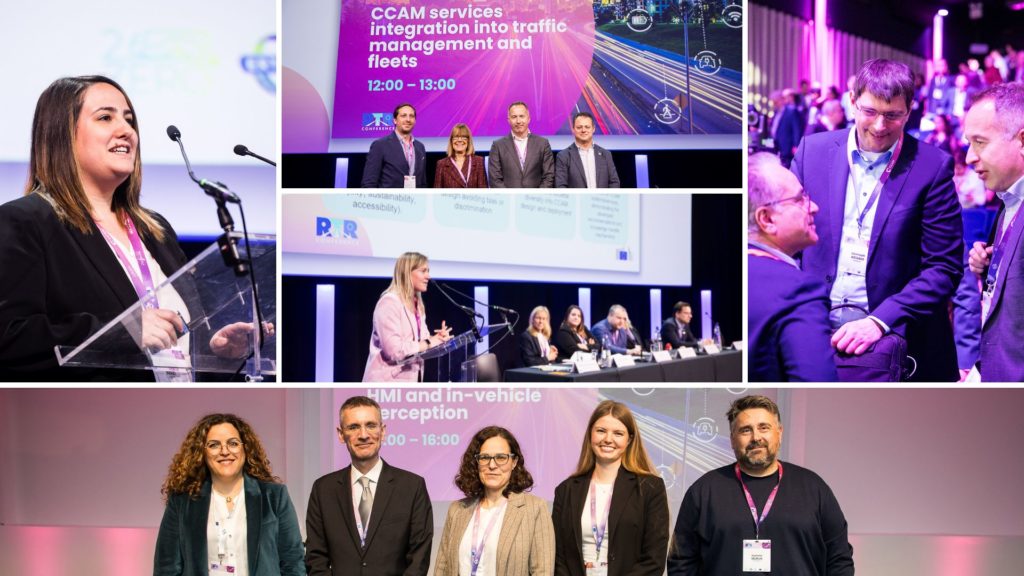
AWARE2ALL and EVENTS highlighted an important part of CCAM deployment: technology needs to work safely, communicate clearly, perform reliably in all conditions. Whereas Hi-Drive and MODI showcased large-scale deployments.
Intuitive HMIs, weather-resilient perception, and large-scale demonstrations all aim to make CCAM systems easy to understand, trustworthy, and ready to operate across Europe. Getting ready for deployment now depends on integration, harmonisation, and field testing, covering everything from interface design to cross-border operations.
Integration and system-wide deployment were key themes, especially through the IN2CCAM and CONDUCTOR presentations. CCAM testing now goes beyond technical checks. It includes scenario-based validation, human-factor modelling, inclusiveness, modal shift, and climate alignment.
Regarding trustworthy AI and system assurance, projects including AIthena, AI4CCAM, and CONNECT highlighted the need for validation, explainability, and governance that can withstand scrutiny in deployment contexts.
The discussion broadened to cover infrastructure-enabled CCAM. Projects such as PoDIUM, AUGMENTED CCAM, iEXODDUS, and FRODDO demonstrated how interoperable infrastructure, shared perception, and digital twin approaches help scale solutions across borders.
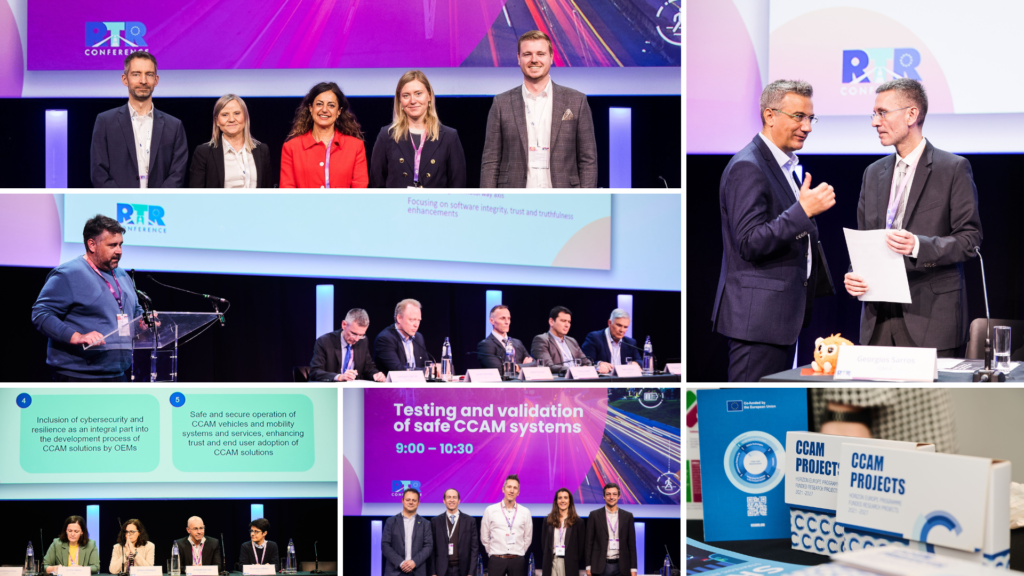
One consistent message across sessions was that CCAM technologies must be resilient by design and socially accepted by default. Without public trust and the ability to handle disruptions, innovation cannot scale, regardless of technological advancement.
As Chairman Christian Merkt stated in the opening session, deployment remains costly and complex. This requires smarter approaches to research, industrialisation, and roll-out amid a challenging geopolitical context. Europe must act with strategic autonomy, and industry must step up to shape the future.
Looking ahead to the next SRIA and the next European partnership, the message is clear:
- Rethink how research and deployment are approached
- Accelerate progress from results to uptake and from pilots to scale
- Keep the big picture in focus: Europe’s competitiveness
The presentations are downloadable through the WeTransfer link until 16 March 2025, and the replays of the CCAM sessions are accessible on the CCAM YouTube Channel.
Source: The original article was published here.